Field Notes: Marrakech
A return to Marrakesh, where memory moves through place and the past finds its way back.

I’ve been here before. More times than I can count. Yet every return feels like the first inhale after being underwater too long. The Medina always resets something in me. The traffic at its edges vibrates like static. Crossing the street is still an act of faith.
When I first arrived in 2008, I was twenty-two with freshly darkened hair and no map. I’d shared a taxi from the airport and followed a man pulling my suitcase on a metal cart into an alley that felt like a tunnel. Kids circled, asking if I needed help, each one insisting they knew the way. They led me deeper until the turns lost meaning. Getting shaken down in the Medina is practically a rite of passage. I didn’t know that then. I ended up in a room that hadn’t been touched since the person before me left it. Sheets creased. I slept there anyway. You can overlook a lot when adventure is the engine moving you forward.
Now, in 2025, I carry less weight and more awareness. The film camera I load by hand feels like an anchor to a former version of myself. My bag still jingles with coins from past lives—rand, rupiah, ringgit, a stray Egyptian pound. I sift through them like an archaeologist tracing old selves.
The biggest shift is the glow of screens. Everywhere, men watch football on their phones, the same match erupting across speakers slightly out of sync. Others listen to guided prayers with private intensity. The Medina used to feel like uninterrupted presence. Now it carries the pulse of two realities at once: feet in the alleys, attention elsewhere.
The Medina carries two realities at once—feet in the alleys, attention elsewhere.
Guéliz dissolves into dust, exhaust, and the rawness of the old city. Cafés spill onto sidewalks. Women pass in long dresses, some veiled, some open-haired. You smell Bab Doukkala before you see it—orange peel, leather, musk, meat, and urine. A man in a wheelchair-cart moves with piston arms. Cats thread between pomegranates.
When I lived here in 2018 and 2019, leading retreats, these alleys became my classroom. The bread men baking underground. The brass workers shaping patterns with ritualistic precision. The spice sellers whispering, “Only today, my friend.” The repetition of work and gesture felt strangely regulating, as craft became its own form of prayer and the pace offered its own stability.
But long before any of that, there was the younger me hitching a ride from Taghazout through the Atlas Mountains with two Welsh surfers, high on hash, surfboards tied to the roof with a rope that shouldn’t have held. The driver took every switchback like he had something to prove. Each turn felt like it might be my last. One of them laughed and said, “Relax your shoulders, mate.” I think of that line every time I’m here.
Memory is spatial. One turn in the Medina and the past reawakens itself.
Now, when I pass the stalls, the same men still sell saffron and sandalwood. The same black hammam soap I can never remember the name of. I no longer follow them upstairs for mint tea, so sweet it hurts my teeth. Presence, I’ve learned, isn’t about saying yes to everything—it’s about choosing where to stay.
In the metalworkers’ souk, near the stretch where produce gives way to cookware just before Rahba Kedima, I see a man I photographed years ago selling tagine pots. The scene is almost unchanged: terracotta stacked in warm towers behind him, his hands moving with the same practice.
My memory places him instantly. The hippocampus maps place onto experience, so coming back here reactivates what was already written. His face is the only real marker of the passage of time. The lines around his eyes have deepened.
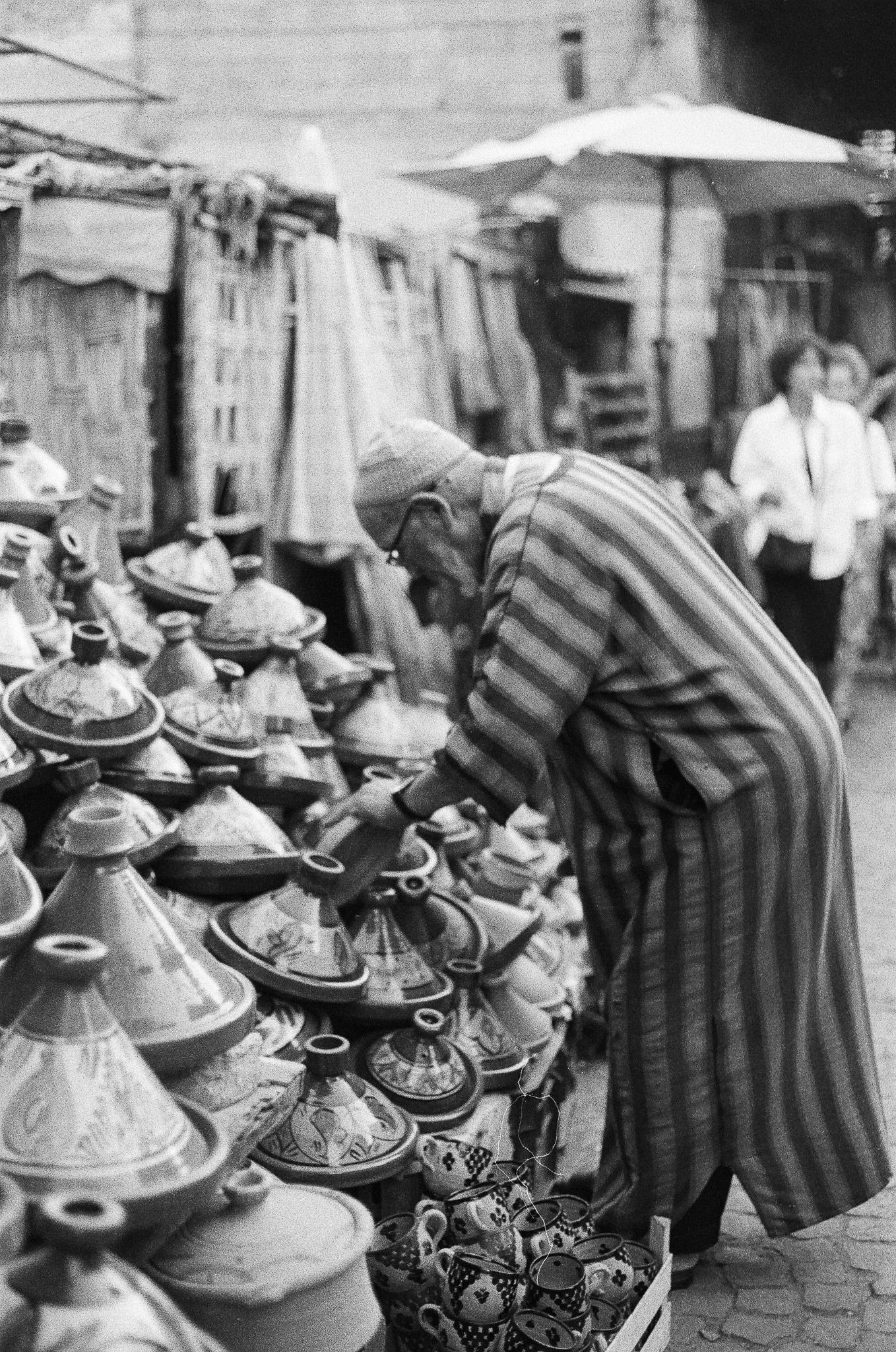
Time announces itself most clearly in the people who never left.
Jemaa el-Fna opens like a living stage. Drums break in the distance. Fruit carts call out with pressed juice—pomegranate, orange, lime, banana for some reason. The henna artists form a constellation of outstretched hands. A man balances pigeons on his shoulders. Another holds a monkey like a tourist prop. The snake charmers are quieter now, carrying a kind of faded fatigue. Once theatrical, now simply there. A ritual that exists because it always has.
The call to prayer moves across the square. Some men stand still. Others continue. The Koutoubia Mosque glows at the margin of dusk. I’ve passed it countless times but rarely stopped. Tonight I do. Its minaret call comes from a different register than the others—deeper, older, almost grainier, like a voice carried through centuries rather than speakers.
I don’t know how I missed that for seventeen years.
Every return tests my sense of direction, but something deeper happens, too. The streets pull memories through the gates, older selves from their hiding place. Not nostalgia, not longing…just recognition in continuity.
Discovery isn’t the rush of something new. It’s the moment something long dormant wakes again. The dopamine is in the return, in the way a place can hold every version of you that’s ever walked its paths.
x
Anna